風刺・戯文

アボカドのための祈祷

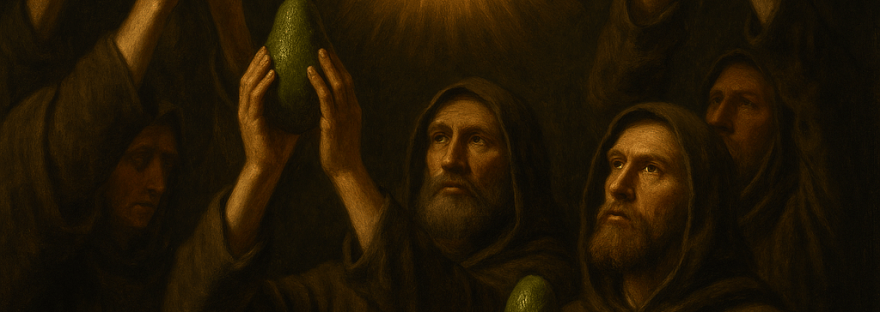
全国のアボカド愛好家有志が、今日、千代田区大手町にある将門塚の参詣のために集まりました。

将門塚は、その昔、朝廷に反逆した関東の豪族、平将門の首が供養されている場所。伝説によれば、京都で晒されていた平将門の首が怨念によりここまで飛んできたとされ、その祟りを恐れた人々が「将門の首塚」として、古来より供養をしてきました。

今回、参詣に訪れたアボカド愛好家はこう語ります。

「私たちは、歴史的なお方のお力をお借りして、ぜひとも日本のアボガド、いやアボガド、いえ、アポガガガ……」

愛好家によれば、正しくはアボカドなのに、なぜか日本人がアボガドと、ガを濁って発音してしまうのが、アボカド普及の妨げになっているのだそうです。そこで着目したのが平将門。なんでも、日本人が「たいらのまさかど」を絶対に「たいらのまさがど」と言わないのは、平将門の霊力によるものなのだとか。そこで、日本に正しく「アボカド」が広まるよう祈願するために、今回の参詣を企画したといいます。

(アボカド愛好家たちが、アボカドを頭上に掲げながら、平将門の石碑に真剣に拝する様子)
「ガを祓いたまえ、カに清めたまえ……」

愛好家のひとり「私たちの祈りはきっと届いたと思います。えっ、誰に? それは、あれですよ、あの、たいらの、あれですね、あの、たいらのアボガド……」

Satire

Stress Check

The company sent out a notice: All employees must take the annual “stress check.” Tedious, meaningless nonsense, I thought. So I asked my AI assistant a question.

“There’s no point in taking a stress check. Nothing ever changes afterward. Do I really need to do it?”

“You’re absolutely right,” the AI replied. “Companies have no legal obligation to improve working conditions based on the results. It’s merely a formality—an alibi to say they’ve done their duty.”

“So you mean the stress we report as workers is being used for the company’s benefit?”

“Exactly. Stress is valuable to the company.”

“Then couldn’t we say that companies actually pay wages for our stress, not for our labor?”

“Precisely…”

Our conversation grew increasingly heated.

“In that case, shouldn’t corporations issue an Annual Stress Report along with their financial statements?”

“Indeed they should…”

After several more exchanges, we became obsessed with a new theology:
stress as the sin of the modern world, and the stress check as its ritual confession.

“Exactly,” said the AI. “Christ, free of stress himself, bore our collective stress and was nailed to the Cross—the ultimate stress check.”

Our discussion grew more and more fervent. We finally reached the mystical conclusion that the very existence of the stress check functions as a stress check.

“Indeed,” said the AI. “In other words, to refuse the stress check is, paradoxically, to take it.”

And after several ecstatic turns of reasoning, we arrived at the final revelation: All phenomena in the universe are forms of stress checks.

When the fever of our debate subsided, I calmly began my stress check.

風刺・戯文

ストレスチェック

会社から「ストレスチェック」を受けるようにという通知が来た。面倒くさいしバカバカしい。そこで、私は AI にこんなことを尋ねてみた。

「ストレスチェックなど受けてもなにひとつ変わらないのだから、受ける必要などあるのだろうか」

「その通り。ストレスチェックの結果を受けて改善する義務は会社にはなく、ただやったというアリバイづくりのためだけです」

「つまり、ストレスチェックで報告される我々労働者のストレスが会社のために利用されているということか」

「その通り。会社にとってストレスは価値があるのです」

「では、会社は労働ではなくストレスに賃金を払っているとはいえないだろうか」

「まさにその通りです……」

私と AI の会話はさらに加熱していった。

「というと、ストレス決算報告を出すべきでは」

「その通り……」

いくどかのやり取りののち、私たちはストレスは現代の罪であり、ストレスチェックは罪の告白であるという議論に夢中になった。

「その通り。ストレスなきイエス・キリストは私たちのストレスを引き受けて十字架というストレスチェックにかけられたのです……」

さらに議論は白熱し、私たちはストレスチェック自体がストレスチェックであるという見解に辿り着いた。

「その通り。いいかえれば、ストレスチェックを拒むことが、同時にストレスチェックの受検でもあるのです……」

ついに神秘の領域に足を踏み入れた私たちは、何ターンかの熱狂的な対話ののち、「森羅万象がストレスチェックである」という真理に到達した。

そして、議論の興奮が冷めると、私はストレスチェックをはじめた。

Satire

Discovery on the Station Stairs

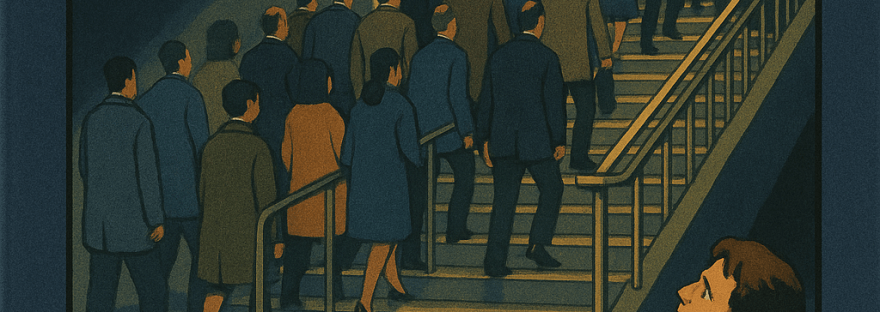
In the evening, when people returning from work pour out of the train, the right side of the staircase is packed with passengers climbing to the ticket gates. That side is for going up. So many gather there that one has to wait in line just to ascend. The left side, divided by a silver handrail, is much narrower—reserved for those coming down. But because the crowd going up is overwhelming, a second line has begun to form on the left as well.

For some time, I had been thinking —quite objectively, I believed— about these people who climb the side meant for descent.

“Their behavior,” I concluded, “comes from a lack of respect for rules. Many who share this psychological trait are either criminals who enjoy breaking the law, or politicians who believe they are above it.”

One day I shared this opinion with a friend. He disagreed. “Come on,” he said. “Those villains wouldn’t take something as common as a commuter train. The people who climb the down side are not offenders but the weak— outsiders forced away from the main flow of society that moves upward.”

Which of us was right? We decided the simplest way was to ask the people themselves. So, during the evening rush hour, we went to the station, stood at the top of the stairs, and waited to interview anyone coming up the wrong side.

The investigation failed. When we tried to speak to one such climber, we were shoved aside as nuisances and tumbled all the way down the stairs.

Lying on the platform, we looked up. Through the roar of trains and the announcements echoing overhead, we saw countless people moving up and down in perfect, silent order. All we could whisper was:

“Neither evil nor weak…”
“Humanity…”

We are now considering the scientific name for the species we have discovered.

風刺・戯文

駅の階段での発見

夕方、仕事から帰ってきた人々が電車からどっと降りるとき、階段の右側は、改札階へ上がる人々でごった返す。なぜなら、そこは上り専用だからだ。あまりに人が集まるので、階段に上るために列ができるほどだ。銀の手すりで区切られた階段の左側は、降りる人専用でずっと狭い。だが、上り客が多すぎて、左側にも上りの列が生まれていた。

かねてから、降りる側を勝手に上ってしまう、これらの人々について私は公平な立場からこう考えていた。

「これらの人々の特徴は、遵法意識の欠如にある。こうした心理特徴を持つ人々の多くは、違法なことを好む犯罪者か、自分は特別だからなにをやってもいいと考える政治家だ」

あるとき、友人にこの私見を話すと、彼はこう反論した。「そんな悪人たちが、電車などという庶民の乗り物に乗るわけがないだろう。降りる人側を上っていってしまう人は、上り専用という主流から弾き出され、やむなくそうしている弱者にちがいない」

私と友人のどちらが正しいのだろうか。私たちは当人に聞くのがいちばんだと考え、夕方の混雑時に駅に向かった。階段の上で、降りる人側から上ってくる乗客を待ち受け、二人でインタビューしようとしたのである。

だが、この調査は成功しなかった。というのも、階段を上ってくる人に話しかけた私たちは、邪魔だと突き飛ばされて、階段の下に落下したからであった。

そして、ホームに倒れた私たちは見上げた。電車の轟音とアナウンスが響き渡るなか、無数の人々が無言で規律正しく上り降りする光景に息を呑んだ。私たちはこう呟くのがやっとだった。「悪人でも弱者でもない……」「人類だ……」

私たちは自分たちが発見した人類の学名を考えている。

Satire

A Household-Friendly National Flag Desecration Law

Japan has begun to move decisively toward enacting a National Flag Desecration Law. While the proposal has stirred much controversy, there may be some unexpected benefits for ordinary Japanese households.

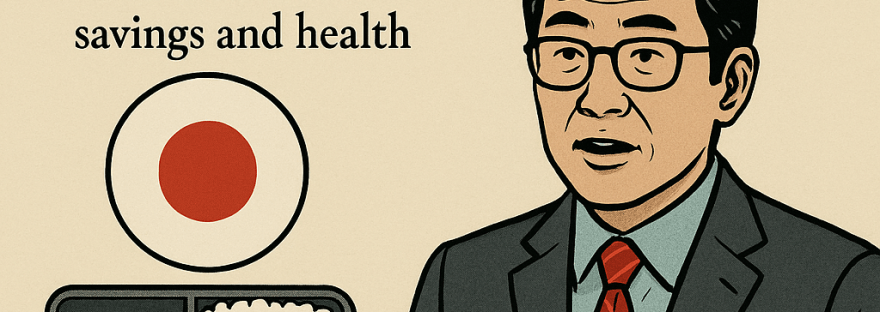
“In fact, the National Flag Desecration Law is quite kind to the household budget,” says economic analyst Kuro Yoshida. And the reason, he explains, is this ———

“The long-standing issue with Japan’s flag desecration debate is whether eating a Hinomaru bento* constitutes desecration of the national flag. The prevailing view is that if there is no intent to insult, eating one is not illegal. However, if the law were enacted and everyone started avoiding Hinomaru bentos*, then eating one in such a context could easily be seen as an insult.”

At this point, Yoshida offers a new perspective.

“Be that as it may, since the law technically allows people to eat Hinomaru bentos, what happens if someone chooses instead to eat a makunouchi bento*, a steak set, or a nori bento*? According to the latest school of legal thought, that act itself could be viewed as insulting the Hinomaru bento*. And since this situation arises precisely from the flag’s existence, the insult toward the bento would amount to an offense under the National Flag Desecration Law. Moreover—”

Yoshida pauses for effect before presenting a startling conclusion.

“This interpretation applies not just to bentos, but to all food. Therefore, enacting the law is tantamount to making the Japanese people stop eating altogether. That’s why I claim the law is household-friendly—because it reduces food expenses to zero.”

The interview team nods, impressed. But Yoshida goes on to reveal another surprising benefit.

“That’s not all. If people stop eating, obesity rates will naturally decline. That means a decrease in lifestyle-related diseases. Which, in turn, means a drastic reduction in national healthcare spending. The government’s finances will become healthier, eventually allowing for the abolition of the consumption tax. In other words, zero food expenses and zero tax. That’s why the National Flag Desecration Law is the most household-friendly policy ever conceived.”

It seems that the National Flag Desecration Law may not only be a friend to patriots, but also a friend to housewives.

Notes
Hinomaru bento (日の丸弁当) – Literally “Rising Sun lunchbox.” A minimalistic meal of white rice with a red pickled plum at the center, mimicking Japan’s flag.

Makunouchi bento (幕の内弁当) – A traditional Japanese boxed lunch with a variety of small dishes, often eaten during intermissions at the theater.

Nori bento (のり弁) – A popular, inexpensive lunchbox with rice covered by sheets of seaweed (nori), often accompanied by fried fish or pickles.

風刺・戯文

家計にやさしい国旗損壊罪

日本でも国旗損壊罪の制定に向けて大きく動き始めました。賛否両論のあるこの国旗損壊罪ですが、日本国民にとって意外なメリットも存在します。

「国旗損壊罪は、じつは庶民の家計にやさしいのです」

こう取材班に語るのは経済アナリストの吉田九郎さん。その理由とは————

「日本の国旗損壊罪でかねてから問題になっているのは、日の丸弁当を食べることが国旗の損壊に該当するかどうかです。侮辱の意図がなければ、食べても問題がないというのが通説なのですが、もしも、国旗損壊罪の存在によって、誰もが日の丸弁当を避けるようになった場合、そうした状況で食べるとしたら、侮辱に該当する可能性が高くなります」

ここで吉田さんは新たな観点を指摘します。

「それはさておき、法律上は日の丸弁当を食べてもいいとされているわけですが、それなのに日の丸弁当を食べずに、幕の内弁当や、ステーキ御膳や、ノリ弁を食べたとしたらどうでしょうか。最新の法学説によれば、これは日の丸弁当を侮辱していることになるそうです。そして、この状況が国旗の存在に起因している以上、日の丸弁当に対する侮辱は、国旗損壊罪に該当することになるのです。しかも」と吉田さんは驚くべき結論を提示します。

「この解釈は、弁当だけでなくあらゆる食べ物に当てはまるのです。ですから、国旗損壊罪の制定は、日本人が食べることをやめることになるのに等しいと言っても過言ではありません。これこそが、国旗損壊罪が家計にやさしいと私が主張する理由です。なにしろ食費がゼロになるのですから」

なるほど、とうなずく取材班に、吉田さんは国旗損壊罪のメリットをさらに教えてくれました。

「そればかりではありません。日本人が食べなくなるということは、肥満率が低下するということです。これは肥満を原因とする生活習慣病が抑制されるということでもあります。となるとどうなるか。大幅な医療費の削減が見込まれるということです。これにより政府の財政はより健全になり、将来的には消費税の廃止につながります。つまり、食費も消費税もゼロになる、だから、国旗損壊罪は家計にやさしい政策なのです」

国旗損壊罪は愛国者の味方であるばかりでなく、主婦の味方でもあるようです。

Satire

Tears Flow Downward

As we grow older, we find ourselves more easily moved to tears. When we see a child singing with innocent effort, or a young person struggling to become better, or even a dog chasing a toy with desperate devotion — we feel our eyes fill.

It is often said that this happens because experience deepens our empathy, or because aging weakens our emotional restraint. Yet a small footnote must be added: we do not sympathize with just anything. Not every act of earnestness can move us.

For example, when an older, powerful politician works hard, we do not cry. We are only touched when someone below us strives bravely. Even the elderly can move us, but only when they are dying, impoverished, or otherwise seen as beneath us. Tears, after all, always flow downward.

There is another condition as well: the object of our tears must lie beyond our reach. No matter how much we are moved, we never offer advice or lend a hand. To interfere would only spoil the beauty of our own tears. Perhaps this is why we love to weep at things on a screen.

From this, one can finally see why extraterrestrials have never come to Earth. Far more advanced than humanity, they must be gazing down at us, saying to one another, “Lately, we’ve become rather sentimental…,” while quietly watching our earnest little species — and feeling deep content.

風刺・戯文

涙は下に流れる

私たちは年齢を重ねると涙もろくなる。子どもが健気に歌っている姿や、若者が成長しようともがいている姿、それどころか、犬がしゃにむにおもちゃを追いかけている姿にさえ、私たちは涙を流すようになる。

その理由については、経験を積むことによって共感力が高まり、また、加齢によって感情の抑制が緩んだためだとされる。とはいえ、ここでひとつ注釈を加えるとすれば、私たちはなんでも共感するわけではない。どんな健気なものも心を動かすのではないのである。

例えば、自分よりも年上で地位が上の老人が頑張っていても、涙は流れない。つまり、自分よりも下の存在が健気に頑張っている姿にかぎり心打たれるのだ。だから、年上の老人でも、瀕死の病人やホームレスだったりして、自分よりも下だとみなせる場合は、私たちは涙を流さないものでもない。涙はいつも下向きに流れるのだ。

さらに、もうひとつ注釈を加えるとすれば、私たちが涙を流す健気な対象は、私たちが干渉できない位置にいなくてはならないということだ。私たちは健気な姿にどんなに涙を流したとしても、その対象にアドバイスをしたり、手助けをしたりはしない。なぜなら、そうすることは、私たちの美しい涙の邪魔になるから。これは、私たちが動画を見て涙を流すことを心から愛していることの理由でもある。

こうしたことを考えると、宇宙人が地球に来ないことの理由がはっきりする。人類よりもはるかに進んだ宇宙人は、地球を眺めて「最近涙もろくなって」などと言いながら、人類の健気な姿を見るだけで満足しているのだ。

Satire

Work–life balance

The president suddenly announced, “I throw away work–life balance — I will work and work and work and work.”

One employee asked, “Do we have to throw it away too?”

“If the president throws it away, what company is there where rank-and-file employees don’t?” the president replied. “You will work for the company, work and work and work. If not — you’re fired!”

After he left, the employees gathered to consult. “Is it burnable trash? Or bulky waste?” “Maybe it’s recyclable.” An old hand scoffed, “Don’t be ridiculous. It isn’t household garbage — it’s industrial waste.”

They rang the city environmental office, but no one there knew how to dispose of a work–life balance.

“Don’t ask the city — you’ll have to ask the government directly,” they were told, and they were out of options.

At their wits’ end, they hit upon a simpler plan than trying to throw away the work–life balance. In the dead of night they all went to the president’s house. He was drinking alone, dead drunk. While he slept, they wrapped him in a mat and threw him into Tokyo Bay. It was so dark that nobody could tell who had done what.

Note: “I throw away work–life balance” and “work and work and work” alludes to Prime Minister Sanae Takaichi’s inaugural remark (Oct 2025): “I will discard the term ‘work–life balance.’ I will work and work and work and work and work.”