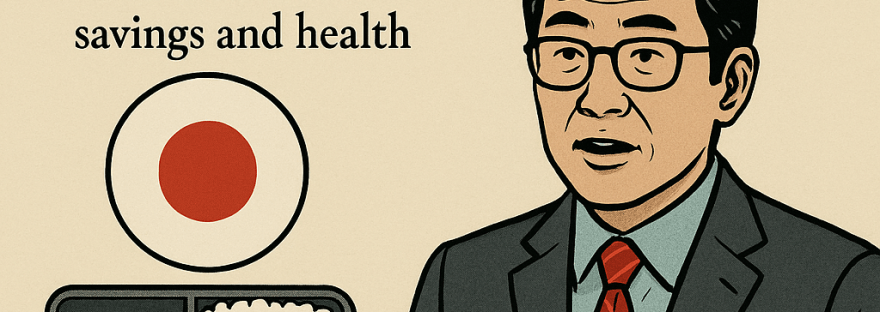
Japan has begun to move decisively toward enacting a National Flag Desecration Law. While the proposal has stirred much controversy, there may be some unexpected benefits for ordinary Japanese households.
“In fact, the National Flag Desecration Law is quite kind to the household budget,” says economic analyst Kuro Yoshida. And the reason, he explains, is this ———
“The long-standing issue with Japan’s flag desecration debate is whether eating a Hinomaru bento* constitutes desecration of the national flag. The prevailing view is that if there is no intent to insult, eating one is not illegal. However, if the law were enacted and everyone started avoiding Hinomaru bentos*, then eating one in such a context could easily be seen as an insult.”
At this point, Yoshida offers a new perspective.
“Be that as it may, since the law technically allows people to eat Hinomaru bentos, what happens if someone chooses instead to eat a makunouchi bento*, a steak set, or a nori bento*? According to the latest school of legal thought, that act itself could be viewed as insulting the Hinomaru bento*. And since this situation arises precisely from the flag’s existence, the insult toward the bento would amount to an offense under the National Flag Desecration Law. Moreover—”
Yoshida pauses for effect before presenting a startling conclusion.
“This interpretation applies not just to bentos, but to all food. Therefore, enacting the law is tantamount to making the Japanese people stop eating altogether. That’s why I claim the law is household-friendly—because it reduces food expenses to zero.”
The interview team nods, impressed. But Yoshida goes on to reveal another surprising benefit.
“That’s not all. If people stop eating, obesity rates will naturally decline. That means a decrease in lifestyle-related diseases. Which, in turn, means a drastic reduction in national healthcare spending. The government’s finances will become healthier, eventually allowing for the abolition of the consumption tax. In other words, zero food expenses and zero tax. That’s why the National Flag Desecration Law is the most household-friendly policy ever conceived.”
It seems that the National Flag Desecration Law may not only be a friend to patriots, but also a friend to housewives.
Notes
Hinomaru bento (日の丸弁当) – Literally “Rising Sun lunchbox.” A minimalistic meal of white rice with a red pickled plum at the center, mimicking Japan’s flag.
Makunouchi bento (幕の内弁当) – A traditional Japanese boxed lunch with a variety of small dishes, often eaten during intermissions at the theater.
Nori bento (のり弁) – A popular, inexpensive lunchbox with rice covered by sheets of seaweed (nori), often accompanied by fried fish or pickles.
 HOROBLOG