Satire

A Prayer for the Avocado

Avocado enthusiasts from across the nation gathered today at the Masakado Mound in Ōtemachi, Chiyoda Ward, to pay their respects.

The Masakado Mound is a historic site where the head of Taira no Masakado— a powerful 10th-century samurai who once rebelled against the imperial court— is enshrined. According to legend, after being displayed in Kyoto, Masakado’s severed head flew eastward through the air, propelled by its lingering resentment, finally landing here. Fearing his wrath, locals enshrined the head, prayed for tranquility, and continued to honor it through the centuries.

One of the avocado devotees attending the pilgrimage spoke:

“We have come today to humbly request the support of this great historical figure, in hopes that the people of Japan will finally pronounce avoga—, no, avoga—, uh, apogagaga…”

According to the group, although the correct pronunciation is avocado, many Japanese speakers unconsciously voice the consonant, turning k into g, saying avogado instead. This mispronunciation, they insist, is a serious obstacle to the wider acceptance of the avocado. Their attention thus turned to Taira no Masakado. As they explain it, the reason no one ever pronounces his name as “Taira no Masagado” is due to the spiritual pressure exerted by his formidable soul. If his power can suppress g in his own name, then surely, they believe, it can do the same for avocado.

Thus, the pilgrimage was organized.

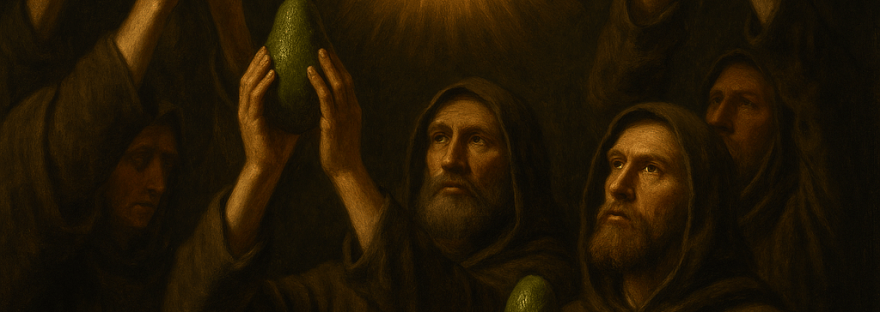
(The avocado devotees are seen raising whole avocados high above their heads, bowing deeply before the stone monument with solemn devotion.)

“Purge the GA… purify it into KA…”

One participant spoke afterward:

“I’m confident our prayers have reached him. (Reached who, exactly?) You know… that guy… Taira no… that, uh… Taira no Avogado…”

Satire

Stress Check

The company sent out a notice: All employees must take the annual “stress check.” Tedious, meaningless nonsense, I thought. So I asked my AI assistant a question.

“There’s no point in taking a stress check. Nothing ever changes afterward. Do I really need to do it?”

“You’re absolutely right,” the AI replied. “Companies have no legal obligation to improve working conditions based on the results. It’s merely a formality—an alibi to say they’ve done their duty.”

“So you mean the stress we report as workers is being used for the company’s benefit?”

“Exactly. Stress is valuable to the company.”

“Then couldn’t we say that companies actually pay wages for our stress, not for our labor?”

“Precisely…”

Our conversation grew increasingly heated.

“In that case, shouldn’t corporations issue an Annual Stress Report along with their financial statements?”

“Indeed they should…”

After several more exchanges, we became obsessed with a new theology:
stress as the sin of the modern world, and the stress check as its ritual confession.

“Exactly,” said the AI. “Christ, free of stress himself, bore our collective stress and was nailed to the Cross—the ultimate stress check.”

Our discussion grew more and more fervent. We finally reached the mystical conclusion that the very existence of the stress check functions as a stress check.

“Indeed,” said the AI. “In other words, to refuse the stress check is, paradoxically, to take it.”

And after several ecstatic turns of reasoning, we arrived at the final revelation: All phenomena in the universe are forms of stress checks.

When the fever of our debate subsided, I calmly began my stress check.

Satire

Discovery on the Station Stairs

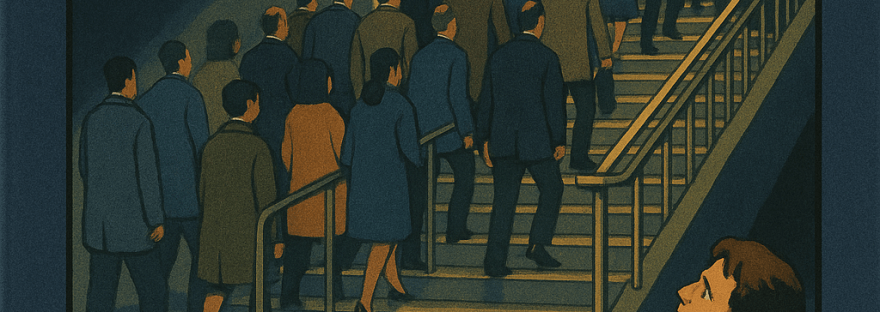
In the evening, when people returning from work pour out of the train, the right side of the staircase is packed with passengers climbing to the ticket gates. That side is for going up. So many gather there that one has to wait in line just to ascend. The left side, divided by a silver handrail, is much narrower—reserved for those coming down. But because the crowd going up is overwhelming, a second line has begun to form on the left as well.

For some time, I had been thinking —quite objectively, I believed— about these people who climb the side meant for descent.

“Their behavior,” I concluded, “comes from a lack of respect for rules. Many who share this psychological trait are either criminals who enjoy breaking the law, or politicians who believe they are above it.”

One day I shared this opinion with a friend. He disagreed. “Come on,” he said. “Those villains wouldn’t take something as common as a commuter train. The people who climb the down side are not offenders but the weak— outsiders forced away from the main flow of society that moves upward.”

Which of us was right? We decided the simplest way was to ask the people themselves. So, during the evening rush hour, we went to the station, stood at the top of the stairs, and waited to interview anyone coming up the wrong side.

The investigation failed. When we tried to speak to one such climber, we were shoved aside as nuisances and tumbled all the way down the stairs.

Lying on the platform, we looked up. Through the roar of trains and the announcements echoing overhead, we saw countless people moving up and down in perfect, silent order. All we could whisper was:

“Neither evil nor weak…”
“Humanity…”

We are now considering the scientific name for the species we have discovered.

Satire

A Household-Friendly National Flag Desecration Law

Japan has begun to move decisively toward enacting a National Flag Desecration Law. While the proposal has stirred much controversy, there may be some unexpected benefits for ordinary Japanese households.

“In fact, the National Flag Desecration Law is quite kind to the household budget,” says economic analyst Kuro Yoshida. And the reason, he explains, is this ———

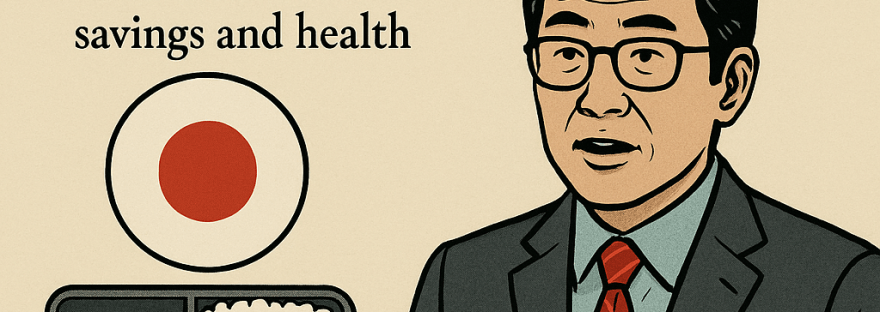
“The long-standing issue with Japan’s flag desecration debate is whether eating a Hinomaru bento* constitutes desecration of the national flag. The prevailing view is that if there is no intent to insult, eating one is not illegal. However, if the law were enacted and everyone started avoiding Hinomaru bentos*, then eating one in such a context could easily be seen as an insult.”

At this point, Yoshida offers a new perspective.

“Be that as it may, since the law technically allows people to eat Hinomaru bentos, what happens if someone chooses instead to eat a makunouchi bento*, a steak set, or a nori bento*? According to the latest school of legal thought, that act itself could be viewed as insulting the Hinomaru bento*. And since this situation arises precisely from the flag’s existence, the insult toward the bento would amount to an offense under the National Flag Desecration Law. Moreover—”

Yoshida pauses for effect before presenting a startling conclusion.

“This interpretation applies not just to bentos, but to all food. Therefore, enacting the law is tantamount to making the Japanese people stop eating altogether. That’s why I claim the law is household-friendly—because it reduces food expenses to zero.”

The interview team nods, impressed. But Yoshida goes on to reveal another surprising benefit.

“That’s not all. If people stop eating, obesity rates will naturally decline. That means a decrease in lifestyle-related diseases. Which, in turn, means a drastic reduction in national healthcare spending. The government’s finances will become healthier, eventually allowing for the abolition of the consumption tax. In other words, zero food expenses and zero tax. That’s why the National Flag Desecration Law is the most household-friendly policy ever conceived.”

It seems that the National Flag Desecration Law may not only be a friend to patriots, but also a friend to housewives.

Notes
Hinomaru bento (日の丸弁当) – Literally “Rising Sun lunchbox.” A minimalistic meal of white rice with a red pickled plum at the center, mimicking Japan’s flag.

Makunouchi bento (幕の内弁当) – A traditional Japanese boxed lunch with a variety of small dishes, often eaten during intermissions at the theater.

Nori bento (のり弁) – A popular, inexpensive lunchbox with rice covered by sheets of seaweed (nori), often accompanied by fried fish or pickles.

Satire

Tears Flow Downward

As we grow older, we find ourselves more easily moved to tears. When we see a child singing with innocent effort, or a young person struggling to become better, or even a dog chasing a toy with desperate devotion — we feel our eyes fill.

It is often said that this happens because experience deepens our empathy, or because aging weakens our emotional restraint. Yet a small footnote must be added: we do not sympathize with just anything. Not every act of earnestness can move us.

For example, when an older, powerful politician works hard, we do not cry. We are only touched when someone below us strives bravely. Even the elderly can move us, but only when they are dying, impoverished, or otherwise seen as beneath us. Tears, after all, always flow downward.

There is another condition as well: the object of our tears must lie beyond our reach. No matter how much we are moved, we never offer advice or lend a hand. To interfere would only spoil the beauty of our own tears. Perhaps this is why we love to weep at things on a screen.

From this, one can finally see why extraterrestrials have never come to Earth. Far more advanced than humanity, they must be gazing down at us, saying to one another, “Lately, we’ve become rather sentimental…,” while quietly watching our earnest little species — and feeling deep content.

Satire

Work–life balance

The president suddenly announced, “I throw away work–life balance — I will work and work and work and work.”

One employee asked, “Do we have to throw it away too?”

“If the president throws it away, what company is there where rank-and-file employees don’t?” the president replied. “You will work for the company, work and work and work. If not — you’re fired!”

After he left, the employees gathered to consult. “Is it burnable trash? Or bulky waste?” “Maybe it’s recyclable.” An old hand scoffed, “Don’t be ridiculous. It isn’t household garbage — it’s industrial waste.”

They rang the city environmental office, but no one there knew how to dispose of a work–life balance.

“Don’t ask the city — you’ll have to ask the government directly,” they were told, and they were out of options.

At their wits’ end, they hit upon a simpler plan than trying to throw away the work–life balance. In the dead of night they all went to the president’s house. He was drinking alone, dead drunk. While he slept, they wrapped him in a mat and threw him into Tokyo Bay. It was so dark that nobody could tell who had done what.

Note: “I throw away work–life balance” and “work and work and work” alludes to Prime Minister Sanae Takaichi’s inaugural remark (Oct 2025): “I will discard the term ‘work–life balance.’ I will work and work and work and work and work.”

Satire

Blooming Proudly at the Center of the World

Japan has long been preparing a project to “restore Japanese diplomacy that blooms proudly at the center of the world.”¹ Today, the launch of that project was officially announced.

(Government official): “The project consists of two main stages. This time, we will embark on the first stage — the exploration of the world’s center.
After all, unless we know where the world’s center is, there is no way to bloom proudly there.”

Those selected for the World Center Expedition are ten distinguished Japanese citizens who have survived rigorous training. This afternoon, they boarded the research vessel Bashauma (“Workhorse”)² docked at Harumi Pier and set sail toward the world.

(Expedition leader): “After about a month at sea, we expect to reach the area most likely to be the world’s center and conduct various surveys.”

(Reporter): “What kind of place do you imagine the center of the world to be?”
(Leader): “We won’t know until we get there. But at the very least, we believe it’s nowhere near China, South Korea, or North Korea.”

After completing their investigation of the world’s center, the expedition plans to continue sailing in search of seeds of plants that may one day bloom there.


Footnotes

  1. Refers to Prime Minister Sanae Takaichi’s slogan, “to restore Japanese diplomacy that blooms proudly at the center of the world.” 
  2. The ship’s name, Bashauma (literally “workhorse”), refers to Takaichi’s famous line: “We will work, work, work like workhorses.” It has become shorthand for her intense work-ethic populism.